


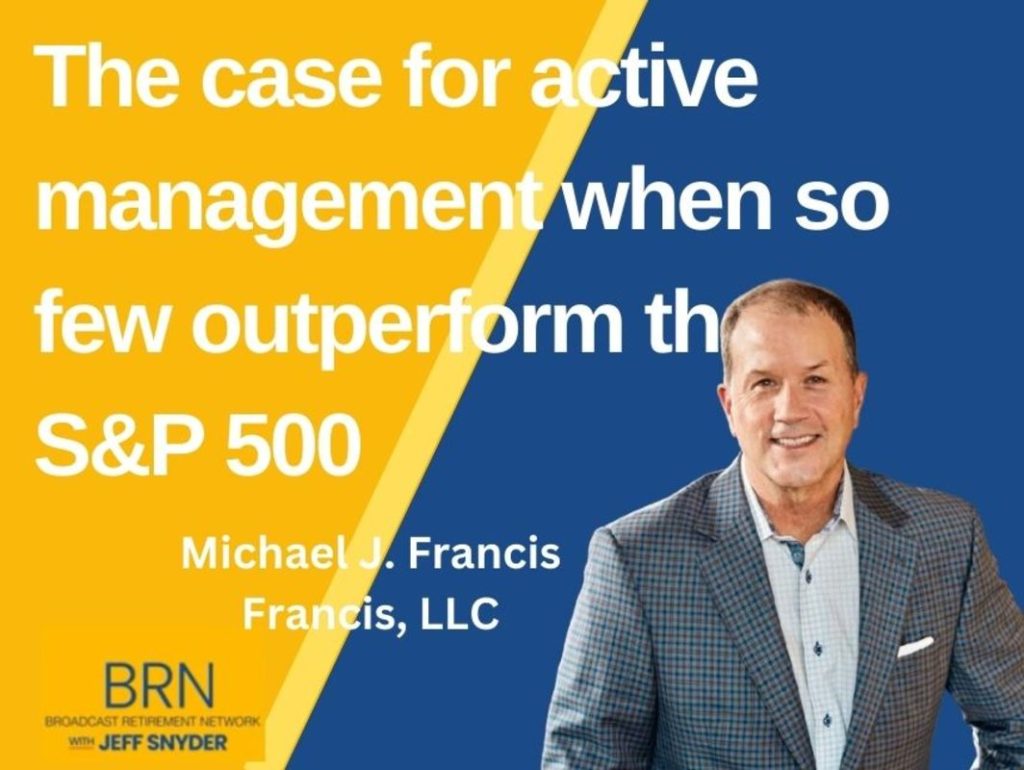
As the debate between active and passive investment management continues, a growing number of investors are turning to active management to outperform the S&P 500, and experts like Michael J. Francis are making the case for why this strategy can be a winning approach in today’s market.
Key Takeaways
- The discussion between Jeffrey Snyder and Michael J. Francis highlights the importance of considering active management as a way to outperform the S&P 500.
- Active management involves a hands-on approach to investing, where a manager actively selects stocks and makes decisions to buy or sell based on their research and analysis.
- Passive management, on the other hand, involves investing in a fund that tracks a specific market index, such as the S&P 500, without attempting to beat the market.
Understanding Active vs. Passive Management
Active management is an investment approach where a manager uses their expertise and research to select stocks and make investment decisions with the goal of outperforming the market. This approach can be beneficial in certain market conditions, such as during periods of high volatility, where a skilled manager can make tactical decisions to minimize losses and maximize gains.
In contrast, passive management involves investing in a fund that tracks a specific market index, such as the S&P 500. This approach is often associated with lower fees and can provide broad diversification and market exposure. However, it may not be the best approach for investors seeking to outperform the market, as it simply aims to match the market’s performance.
Context: Why This Matters Now
The current market environment is characterized by rising inflation, which can erode the purchasing power of investments and reduce their value over time. In this context, active management can be a more effective approach, as a skilled manager can select stocks that are better positioned to withstand inflationary pressures. For example, imagine an investor who buys into a fund that tracks the S&P 500, only to see their returns eroded by inflation. In contrast, an active manager may be able to select stocks in sectors that are less affected by inflation, such as technology or healthcare.
Historically, active management has been shown to outperform passive management during certain market conditions, such as during the 2008 financial crisis, when many actively managed funds were able to navigate the market downturn more effectively than their passively managed counterparts. Similarly, during the 2021 tech boom, many active managers were able to capitalize on the growth of technology stocks and deliver strong returns to their investors.
Pros and Cons for Your Portfolio
- Risk: One potential downside of active management is the risk of underperformance, which can occur if the manager’s investment decisions do not pan out as expected. This can result in lower returns than the market as a whole, and may even lead to losses if the manager takes on too much risk.
- Opportunity: On the other hand, active management can provide the opportunity for outperformance, which can be particularly attractive in today’s market environment. By selecting stocks that are well-positioned for growth and avoiding those that are likely to underperform, an active manager can potentially deliver higher returns than the market as a whole.
What This Means for Investors
For investors considering active management as a way to outperform the S&P 500, it’s essential to carefully evaluate the potential risks and benefits. This may involve researching different investment strategies, assessing the track record of potential managers, and considering factors such as fees and risk tolerance. Ultimately, the decision to invest in an actively managed fund will depend on an individual’s investment goals, risk appetite, and time horizon.
As Michael J. Francis and Jeffrey Snyder’s discussion highlights, active management can be a powerful tool for investors seeking to outperform the market. By understanding the pros and cons of this approach and carefully evaluating the potential risks and benefits, investors can make informed decisions about their investment portfolios and potentially achieve their long-term financial goals.

 Apple Stock Surges to Record $143B: What’s Behind the Swing
  Nvidia’s $100B Reality Check: What Investors Need to Know
  Cathie Wood Snaps Up $1.9M Megacap Tech Stock: What’s Next?
  J.P. Morgan Ups Gold Price Forecast for 2026: Key Implications
  Nvidia Stock Surges: Morgan Stanley Raises Price Target Aggressively
  Fidelity Warns: Recession Imminent, Are You Prepared