

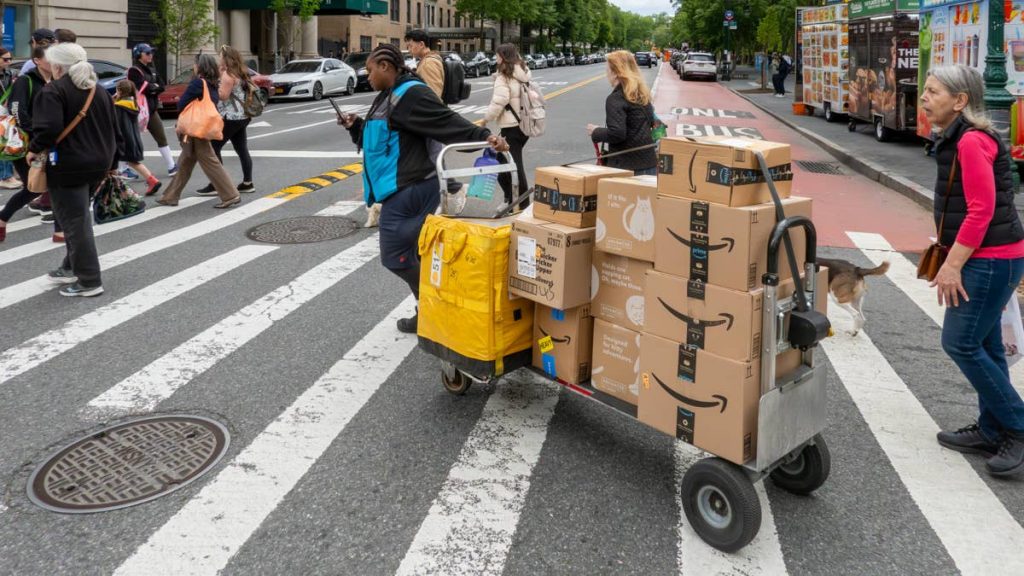
Amazon’s ultra-fast delivery service is set to revolutionize the e-commerce landscape, forcing investors to reevaluate their portfolios and consider the implications of a rapidly changing retail environment.
Key Takeaways
- Amazon’s ultra-fast delivery service is expanding to more cities, further solidifying the company’s commitment to faster and more convenient shipping.
- The service is expected to increase customer satisfaction and loyalty, potentially driving long-term revenue growth for Amazon.
- The rise of ultra-fast delivery may also lead to increased costs for Amazon, potentially impacting profitability and investor returns.
Amazon Fast Delivery Revolution: Beating the Competition
Amazon has been at the forefront of the e-commerce revolution, continuously pushing the boundaries of what consumers expect from their online shopping experience. The company’s ultra-fast delivery service is the latest innovation in this space, offering customers same-day, one-day, or even same-hour delivery in select areas. This service is a key differentiator for Amazon, setting it apart from competitors and further solidifying its position as the leading e-commerce platform.
The ultra-fast delivery service is made possible by Amazon’s vast network of warehouses, delivery stations, and last-mile logistics providers. By strategically locating these facilities near major population centers, Amazon is able to reduce delivery times and increase the speed of its shipping operations.
Context: Why This Matters Now
The rise of ultra-fast delivery is closely tied to the growing demand for convenience and speed in the retail landscape. Consumers are increasingly expecting fast and flexible delivery options, driving companies to invest in logistics and supply chain infrastructure to meet this demand.
Similar to the 2008 financial crisis, which accelerated the shift towards e-commerce, the COVID-19 pandemic has further accelerated the growth of online shopping. According to a recent report, online sales grew by over 20% in 2020, with consumers increasingly turning to digital channels for their shopping needs.
Pros and Cons for Your Portfolio
- Risk: The increased costs associated with ultra-fast delivery may impact Amazon’s profitability, potentially reducing investor returns.
- Opportunity: The rise of ultra-fast delivery may drive long-term revenue growth for Amazon, potentially leading to increased stock prices and higher returns for investors.
What This Means for Investors
For investors, the implications of Amazon’s ultra-fast delivery service are significant. As the company continues to expand its logistics and supply chain infrastructure, investors should consider the potential impact on profitability and stock prices.
One strategy for investors may be to overweight Amazon in their portfolios, given the company’s dominant position in the e-commerce landscape and its commitment to investing in logistics and supply chain infrastructure. However, investors should also consider the potential risks associated with ultra-fast delivery, including increased costs and reduced profitability.
Defining Concepts: Inflation and its Impact on E-commerce
Inflation is a key economic concept that can impact e-commerce companies like Amazon. Inflation occurs when the general price level of goods and services in an economy increases, reducing the purchasing power of consumers and leading to higher costs for businesses.
Imagine an investor who bought $100,000 worth of Amazon stock in 2019. If inflation were to rise to 3% per annum, the investor’s purchasing power would be reduced, as the same $100,000 would be able to buy fewer goods and services in 2020 than it could in 2019.
This could have significant implications for Amazon’s business, as the company would need to adjust its pricing strategy to account for the increased costs associated with inflation. If Amazon were unable to pass on these costs to consumers, it could lead to reduced profitability and lower stock prices.
Hypothetical Examples: The Impact of Ultra-Fast Delivery on Amazon’s Stock Price
Imagine an investor who bought 1,000 shares of Amazon stock in 2020, at a price of $1,500 per share. If Amazon’s ultra-fast delivery service were to drive long-term revenue growth, the investor’s shares could increase in value, leading to higher returns.
For example, if Amazon’s stock price were to increase by 20% per annum, the investor’s 1,000 shares would be worth $1.8 million in 2025, assuming the same number of shares.
However, if Amazon’s ultra-fast delivery service were to lead to increased costs and reduced profitability, the investor’s shares could decrease in value, leading to lower returns. For example, if Amazon’s stock price were to decline by 10% per annum, the investor’s 1,000 shares would be worth $1.4 million in 2025, assuming the same number of shares.
Historical Context: The Rise of E-commerce and its Impact on Retail
The rise of e-commerce has had a profound impact on the retail landscape, with many companies struggling to adapt to the changing consumer behavior. Similar to the 2008 financial crisis, which accelerated the shift towards e-commerce, the COVID-19 pandemic has further accelerated the growth of online shopping.
Companies that were early adopters of e-commerce, such as Amazon, have been able to capitalize on this trend, driving long-term revenue growth and increasing their market share. However, companies that were slow to adapt have struggled to compete, leading to reduced sales and lower stock prices.

